 Родовід Архів
On this page
Rights and licenses
We will send the full legal version of these terms by email on request. The content is the same.
Seller: Oleksandr Slobodianiuk, a registered sole proprietor in Portugal, Lisbon (in Portuguese, trabalhador independente). The tax number and address are on the invoice. Write to pytannia@rodovidarchive.com: questions, corrections, deletion, complaints. We answer in Ukrainian or English.
Order terms: €19, refunds, 14 days
The search costs €19. The written report with the findings arrives within five days after the questionnaire, if it asks to start right away: we cannot start the search without your details, so these five days are counted from the day you complete the questionnaire. Without that request, we first wait out the 14-day withdrawal period, counted from the day of payment, and the report arrives within five days after that period. The €19 counts in full toward any work that follows: Family after the search costs €471 instead of €490. Family and Heritage can also be ordered right away, under the card hold terms below. Which tier fits your books, we say in the report.
Family and Heritage right away: the amount is held, not charged. When you order Family (€490) or Heritage (€990) without a separate search, we hold that amount on your card and do the search first; it is included in the price. If the search names files containing readable books for your parish for at least one line of the family, we charge the held amount and start the research. If the search recommends only Family for a Heritage order, we charge €490 and release the rest. If the search names no books, we release the hold and do not charge your card; the bank usually releases the amount within a few days, and you keep the search report free of charge. The bank holds the amount for 7 days, so we give dates in the email after payment: if you have not submitted the questionnaire by the first date, we release the hold and close the order; if you have submitted it but the report is not ready by that date, we charge the amount that day, and if the search later names no books, we refund it in full the same way you paid. The bank uses its own exchange rate for holds and refunds. We charge nothing above €990 for Heritage without your separate consent and separate payment. Until the search has started, you can cancel by email: we release the hold or refund the charged amount in full. The €19 refund terms above apply to a search paid for separately.
Refunds. After the report is delivered, we return the €19 only when the catalog shows no book of your parish for the years 1850–1917. If the books survive but are not scanned, that is not grounds for a refund: we offer a paid order for copies from the archive, and the €19 counts toward its price. A free index is not grounds for a refund: through it we find entries faster and check each one against the page of the book. If we offered paid continuation and you did not order it, the €19 is not returned: it paid for the report. If the report is delayed and we have written you a new date, we return the payment on a single reply from you to that letter.
Canceling before work starts. As long as the search has not started, you may cancel the order by email, and we return the €19 in full.
What is not returned. If you ordered a reading of the books and the surname did not turn up in the books read, that is not grounds for a refund. Then you get a report on the books checked and a proven “no entry.” If the sources turned out to be unreachable, the unspent part is returned regardless of the size of the order.
14 days to withdraw. The service is ordered over the internet, so EU law gives you 14 days to change your mind without explanation and get your money back. Paying itself does not take this right away from you.
Only your own request to start earlier takes it away. You tick this sentence on the last step of the questionnaire: “I ask to start the work right away and understand that the right to withdraw is lost for the part already done.” For Family and Heritage there are two ways: press the button carrying this sentence in your account, or write the same sentence in reply to the email with the search report. We keep the text and time of the request. If you withdraw after that, you pay only for the part already done, and the rest is returned. Without that sentence we do not start until 14 days have passed, or until you send it. One email to pytannia@rodovidarchive.com is enough to withdraw. We return the money the same way you paid, within 14 days of your email.
What we do not sell. Nothing physical: no printed book, no shipping. The result is always a page behind a link and a written report.
Ancestors’ data: records older than 75 years
Personal-data-protection law does not cover the deceased. But we do not take records younger than 75 years at all: they are closed and held by the civil registry office.
There are no living people in the tree. If a living person turns up in the material, we do not create a card for them, and we mark the link as “exists, not shown.” That is how it is in your tree, and in every example on this site.
Your data, and the 5 services that process it
- We ask only for what you write in the questionnaire: where the family came from, the surname and its spellings, the earliest known ancestor, the rite, what you have already tried, documents if you choose to add them, and the language for our reply. You mark any living people in the email yourself; we do not add them to the tree. Stripe sees the name, email and card. Nothing more.
- The tree lives behind a link, under a password, and is encrypted: the file cannot be read without the password. The page is closed to search engines.
- We do not show your tree to anyone and do not use it as an example without your separate written request.
- We do not sell your data and pass it only to services without which the order or the site chat technically does not work: Stripe (payment, we never see the card number at all), Google (our email, and sign-in with Google if you choose it), Cloudflare (hosting for these pages, the visit counter, your account and the free check form), GitHub (GitHub Pages, hosting for your password-encrypted tree), Anthropic (the site chat: the text of the messages you write in the chat, and only if you use it; research for your order: the questionnaire answers and the records found; letters to our mailbox and requests from the free check form; details under Artificial intelligence).
- There are no ad networks on the site. There is our own visit counter, and it
stores no data about you: only which pages are opened and which buttons are
pressed, the country, which site or ad campaign the visit came from (the campaign name and a “from a Google ad: yes/no” mark, never the click id), the type of device, and whether a search found a village or a surname in
our catalog. It stores nothing on your device: no cookies or other records. One exception that you
turn on yourself: if you open the site with
?rv=offat the end of the address, this browser keeps a single note that the counter is off for it, and?rv=onremoves the note. Your account and the page after payment remember the chosen language in this browser. A click on a buy button carries a one-time code that links the source of that visit to the order. We do not record your IP address, nor a word of what you type into a search, nor anything that points to you specifically. To tell one visitor from another, the server turns the IP address and the browser’s name into a one-way code with a random key that changes every day; the address and browser name themselves are never recorded anywhere, old keys are deleted, and the next day the same visitor gets a different code. The records are kept in the EU and are deleted after 400 days. If your browser sends Do Not Track or Global Privacy Control, the counter sends nothing. No page makes any external request: the counter writes to this same site, and the map in the demo tree is drawn from data that lives here too. There is one exception, and only when you write in the chat or fill in the free check form: before your first question or request the browser loads a “not a robot” check (Cloudflare Turnstile) from a Cloudflare server. - The free check form asks for the surname, what you know about the place, approximate years (optional) and your email; the address of the page you sent it from comes with them. All of it serves only to answer you. The request reaches us as a letter: its copy in our working mailbox is deleted after 90 days, and the correspondence about it is kept like every letter, for up to 24 months. So that the form is not flooded, the server counts requests by a one-way code of the IP address and of the email address, made with a secret key; the addresses themselves are not written into the counter, and it is cleared after a day. If you open the link in our answer, we open an account for that address, with no password: it holds the surname and place from the request and our answer until you delete the account in its settings. The link works for 30 days; a request with no account is deleted with the letter after 90 days. We keep the “send me offers” box with the request; without it we send you nothing but the answer.
- When you write to us by email, we keep the correspondence (your letters and our replies) for up to 24 months, to answer follow-up questions and to understand which of our letters were useful. Then we delete the text and keep only the date and the fact of contact. You can ask us to delete it earlier by writing to pytannia@rodovidarchive.com.
- Ask us to delete it, and we delete it along with the working materials. One email to pytannia@rodovidarchive.com is enough, no explanation needed.
Your account: what it holds and for how long
- Your account opens after payment. You sign in with Google, with an email and a password, or by a sign-in link sent to your email. From Google we get only your email address and your Google account ID, no name and no photo. We keep a password only as a one-way code.
- Your account holds your email, the name from the payment, the questionnaire, the relatives’ cards, your messages with us and the order status. It has no card number. All of it is stored in a Cloudflare database in the EU. Only you and we can see it; for the research, Anthropic processes the questionnaire answers and the records found (see Artificial intelligence), and we pass it to no one else.
- If you add living relatives, write only what the search needs, and tell them we hold this data and that Anthropic processes it.
- The account sets one sign-in cookie for 30 days. Page scripts cannot read it. During sign-in with Google one or two more are added for 10 minutes and removed once you are in. The tree window remembers its language and layout on your device. To stop password guessing, the server counts sign-in attempts by a one-way code of the IP address and does not record the address itself.
- We keep your account data while your account exists. You can delete it in the account settings or with one email to pytannia@rodovidarchive.com. We act on the email within 30 days. Database backups disappear within 30 days.
- After deletion two records stay: the payment (amount, date, Stripe payment number) and, if you asked us to start right away, the text and time of that request. No name and no email. We need them for accounting and in case of a dispute.
- If you paid but have never opened your account, we delete the name and email from the payment after 24 months.
Sources, and Article 20 of the Archives Law
- Open archive catalogs, scans held by state archives, Wikimedia mirrors, free indexes.
- We do not bypass paywalls, do not solve captchas, do not log in under someone else’s account, and do not download anything that robots.txt forbids.
- Scans remain the property of the archives. In the report we give a crop and a link to the frame, and we do not resell anyone else’s images.
Indexes compiled by others
The "What else is known about this place" references on Kyiv Oblast pages are drawn from open indexes published under the MIT license: Copyright (c) 2026 Volodymyr Stetsenko. The indexes of the revision lists DAKO ф. 280 оп. 2 were transcribed by the editors of Ukrainian Wikisource, license CC BY-SA 4.0.
Text of the MIT license
Copyright (c) 2026 Volodymyr Stetsenko. Permission is hereby granted, free of charge, to any person obtaining a copy of this software and associated documentation files (the "Software"), to deal in the Software without restriction, including without limitation the rights to use, copy, modify, merge, publish, distribute, sublicense, and/or sell copies of the Software, and to permit persons to whom the Software is furnished to do so, subject to the following conditions: The above copyright notice and this permission notice shall be included in all copies or substantial portions of the Software. THE SOFTWARE IS PROVIDED "AS IS", WITHOUT WARRANTY OF ANY KIND, EXPRESS OR IMPLIED, INCLUDING BUT NOT LIMITED TO THE WARRANTIES OF MERCHANTABILITY, FITNESS FOR A PARTICULAR PURPOSE AND NONINFRINGEMENT. IN NO EVENT SHALL THE AUTHORS OR COPYRIGHT HOLDERS BE LIABLE FOR ANY CLAIM, DAMAGES OR OTHER LIABILITY, WHETHER IN AN ACTION OF CONTRACT, TORT OR OTHERWISE, ARISING FROM, OUT OF OR IN CONNECTION WITH THE SOFTWARE OR THE USE OR OTHER DEALINGS IN THE SOFTWARE.
Archive frames on this site
These are documents from the open resources of state archives. Showing them is allowed by Article 20, paragraph 6 of the Law “On the National Archival Fund and Archival Institutions” («Про Національний архівний фонд та архівні установи»): publishing the content of archival documents is allowed “with a reference to their place of storage” («з посиланням на місце їх зберігання»). That is why under every image there is the full reference: archive, fond, opys, sprava (collection, inventory, file), frame number.
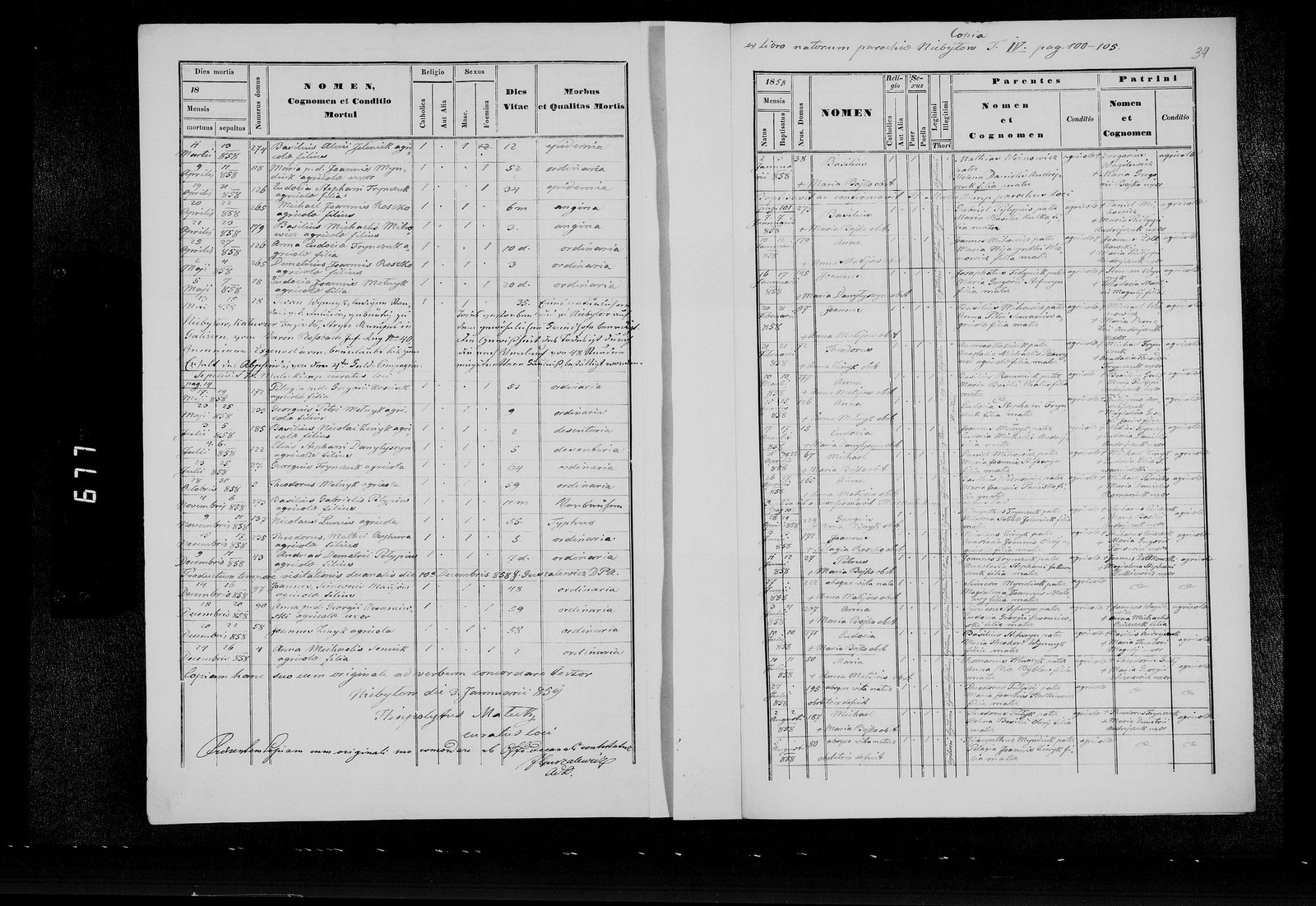
For commercial work the law (Article 21, paragraph 5) requires advance notice to the archive. Before the first paid reading in an archive’s fonds, we send it a letter with this site’s address. If the archive considers a separate agreement necessary, we will sign one.
Artificial intelligence
Software reads the pages first, and a person checks every fact against the scan. The software holds the structure of a record and the frame numbers well, and reads names poorly; the measurement on a real page, with the failed numbers, is on the Method page. That is why Family takes 4–6 weeks, and the term of Heritage is agreed together with its scope. An illegible spot stays empty: inventing a name from the context of the era is forbidden here.
In the site chat a program answers, not a person. It is the Claude language model of Anthropic (USA), which the site calls through the Claude API. In the chat it is given only the texts of this site: it does not look for ancestors and does not see your account or any order. The chat is optional: everything it knows is written on the pages of this site, and you can write to a person at pytannia@rodovidarchive.com.
- What is sent to Anthropic. The text of the chat messages: your new question together with the earlier questions and answers of the same conversation. Anthropic processes this text for us in order to compose the answer. From the chat we do not send your IP address, the address of the page, your email or any order data there. How long Anthropic keeps this text on its side is set by its terms for the API. So please do not write passport details in the chat, or anything you do not want to pass on.
- What is sent to Anthropic for an order. The answers in your questionnaire (names, years and villages of ancestors and of the living relatives you entered) and the records found. Anthropic (Claude API) processes them for us in order to do the research. Under Anthropic’s commercial API terms this data is not used to train models. Anthropic deletes it from its servers automatically within 30 days.
- What is sent to Anthropic from letters and the check form. Your letter to our mailbox, or your request from the free check form (surname, what is known about the place, years, email), is read by Claude, a model of Anthropic, in order to prepare and send a reply. We pass it nothing else. How long Anthropic keeps this text on its side is set by its terms.
- What we keep. The text of the questions and answers, the language and the time, in a Cloudflare database in the EU, with no IP address and no link to an account or an order. We read these records to see where the chat answered badly. They are deleted after 30 days.
- To limit the number of questions per day, the server counts them by a one-way code of the IP address with a secret key; the code is different every day, and the address itself is not recorded. These counters are erased within three days. The chat itself stores nothing on your device: no cookies or other records, and the conversation is gone when you close the page.
- If the chat has no answer, it offers to leave an email address so that a person can reply. Then, with your consent, we keep the address and the question until we have replied, and erase them once 30 days have passed since your request.
There are no testimonials or coats of arms on this site
There are no testimonials here. We do not write them and do not buy them. A testimonial is published only with a name, a date and the client’s written permission. The work can be checked without testimonials: a proven “no entry” and the full 1891 case, where every frame opens.
- Accounts in the name of invented people.
- Bought activity.
- Coats of arms “attached” to a surname. A coat of arms belonged to a specific family line; a surname does not carry it.